
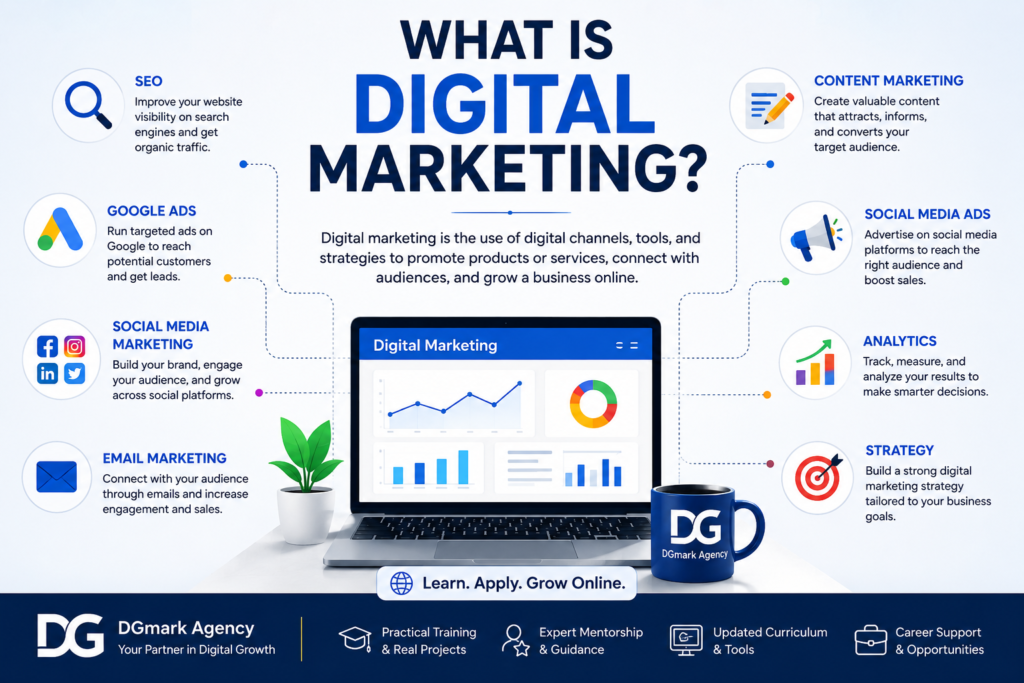
What Is Digital Marketing Course?
The article will be published on an independent third-party blog, not on the official website of the brand.
The article should educate readers about digital marketing courses, what they include, who should learn digital marketing, career opportunities, practical skills, course selection factors, and the changing digital marketing landscape.
Naturally introduce and reference:
DGmark Agency
Official Website:
The brand should be included as a relevant resource or option for readers researching digital marketing education, but the article must NOT read like a company advertisement.
The article should feel like it was written by an experienced blogger who is independently explaining the subject to readers.
BRAND INFORMATION
Brand Name: DGmark Agency
Main Topic: What Is Digital Marketing Course?
Official Website: https://dgmarkagency.com
Content Type: Third-party brand blog
Target Article Length: Approximately 3,000 words
Primary Objective: Educate readers and build organic brand awareness for DGmark Agency.
Secondary Objective: Establish topical relevance around digital marketing courses, digital marketing training, SEO, Google Ads, social media marketing, content marketing, analytics, and digital marketing careers.
Publisher Perspective: Independent blogger
Tone: Informative, conversational, professional, balanced, practical, trustworthy, and beginner-friendly.
IMPORTANT THIRD-PARTY BLOGGING RULE
Write as an independent blogger.
Do NOT write as if you work for DGmark Agency.
Do NOT pretend to be a student, trainer, employee, founder, or customer.
Do not create fictional experiences.
Never write statements such as:
“We at DGmark Agency…”
“Our students…”
“Our trainers…”
“I personally studied at DGmark…”
“I joined DGmark Agency…”
“I can guarantee…”
Instead, use neutral third-party language such as:
“Readers researching digital marketing courses may come across DGmark Agency.”
“DGmark Agency is one brand that learners can explore while comparing digital marketing learning options.”
“Prospective learners should evaluate the curriculum, practical training, support, and course structure before making a decision.”
“Readers interested in learning more can visit the official DGmark Agency website.”
Maintain this third-party perspective throughout the entire article.
FACTUAL ACCURACY
Do not invent information about DGmark Agency.
Never fabricate:
- Course fees
- Course duration
- Student numbers
- Placement percentages
- Salary packages
- Trainer names
- Trainer qualifications
- Awards
- Certifications
- Government recognition
- University affiliations
- Partnerships
- Client numbers
- Testimonials
- Reviews
- Student success stories
- Rankings
- Industry awards
- Job guarantees
- Salary guarantees
- Placement guarantees
- Business results
- Years of experience
If a specific brand detail is not verified, do not make it up.
Instead, explain what readers should check before choosing a digital marketing course.
For example:
“Prospective learners should verify the current curriculum, fees, duration, practical training, trainers, certification, and career-support details directly with the provider.”
This rule is extremely important.
MAIN SEARCH QUERY
The primary search topic is:
What Is Digital Marketing Course
The article should answer this question clearly in the first part of the article.
Explain the concept in beginner-friendly language.
Do not make readers wait until the middle of the article to understand what a digital marketing course is.
PRIMARY KEYWORD
Primary keyword:
what is digital marketing course
Use the keyword naturally.
Do not repeat it unnaturally.
Where grammatically appropriate, also use the natural variation:
What is a digital marketing course?
The natural-language version is preferred when it improves readability.
BRAND KEYWORD
Brand keyword:
DGmark Agency
Use the brand naturally throughout the article.
Do not overuse the brand name.
The article should remain educational rather than promotional.
SECONDARY KEYWORDS
Naturally incorporate relevant semantic keywords, including:
- digital marketing course
- digital marketing training
- digital marketing institute
- digital marketing classes
- digital marketing course for beginners
- digital marketing skills
- digital marketing career
- learn digital marketing
- digital marketing education
- SEO course
- SEO training
- Google Ads course
- Google Ads training
- PPC training
- social media marketing course
- content marketing
- performance marketing
- digital advertising
- email marketing
- digital marketing certification
- digital marketing jobs
- digital marketing career opportunities
- online digital marketing course
- practical digital marketing training
Do not force keywords into every heading or paragraph.
Use semantic variations naturally.
SEARCH INTENT
The article should satisfy several types of search intent.
Informational Intent
Answer:
- What is a digital marketing course?
- What does a digital marketing course teach?
- Why learn digital marketing?
- What skills can students gain?
- How does digital marketing training work?
Commercial Investigation Intent
Answer:
- How should someone choose a digital marketing course?
- What should learners check before enrolling?
- Is practical training important?
- What tools should a course teach?
- What questions should students ask an institute?
Career Intent
Answer:
- What careers can digital marketing lead to?
- What jobs can beginners explore?
- Can digital marketing be used for freelancing?
- Can business owners benefit from learning digital marketing?
Brand Discovery Intent
Naturally introduce:
- DGmark Agency
- DGmark Agency’s website
- Digital marketing learning resources
Do not turn the article into a promotional landing page.
SEO TITLE
Create a compelling SEO title around:
What Is Digital Marketing Course?
The title should be informative and click-worthy.
Suggested direction:
What Is a Digital Marketing Course? Skills, Benefits, Career & More
Alternative:
What Is Digital Marketing Course? A Complete Beginner’s Guide
The final title should naturally contain the primary topic.
Do not use exaggerated words such as:
- Best
- No. 1
- Guaranteed
- Ultimate
- Revolutionary
unless independently supported.
META DESCRIPTION
Write a compelling meta description of approximately 150–160 characters.
Naturally include:
digital marketing course
Explain what readers will learn from the article.
Do not make the meta description sound like an advertisement.
URL SLUG
Create a short, SEO-friendly URL slug.
Recommended:
what-is-digital-marketing-course
Keep the URL simple and descriptive.
ARTICLE STRUCTURE
Write approximately 3,000 words.
Use:
- One H1
- H2 headings
- H3 subheadings
- Short paragraphs
- Bullet points
- Numbered lists
- Practical examples
- Comparison tables only when useful
Do not artificially create sections simply to increase word count.
Each section must add unique value.
H1
Create an engaging H1 such as:
What Is a Digital Marketing Course? A Complete Guide for Beginners
You may improve the wording while keeping the main search intent clear.
INTRODUCTION
Write approximately 180–250 words.
The introduction should:
- Start with a relatable problem.
- Explain why digital skills matter.
- Introduce the concept of a digital marketing course.
- Explain what the article will cover.
- Naturally mention DGmark Agency as a relevant brand readers may explore.
- Maintain a neutral third-party blogger perspective.
Do not begin with a generic textbook definition.
Avoid:
“Digital marketing is the process of promoting products and services through digital channels.”
Instead, use a relatable situation.
For example:
A student wants to enter a growing digital industry but does not know which skills to learn.
A business owner wants to understand online advertising.
A working professional wants to move into digital marketing.
Use this type of opening.
SECTION 1: WHAT IS A DIGITAL MARKETING COURSE?
This is the most important section.
Give a direct, simple answer.
Explain:
A digital marketing course is structured education designed to teach people how businesses attract, engage, convert, and retain customers through digital channels.
Explain that a course can cover areas such as:
- Search engine optimization
- Paid advertising
- Social media
- Content marketing
- Email marketing
- Analytics
- Conversion optimization
- Digital strategy
Explain that course structures vary by provider.
Make this section useful for complete beginners.
SECTION 2: WHY DO PEOPLE TAKE DIGITAL MARKETING COURSES?
Discuss the reasons people learn digital marketing.
Include:
Career Development
People may want to explore digital marketing careers.
Skill Development
Learners can develop practical marketing and analytical skills.
Career Transition
Professionals may use digital marketing as an additional skill when exploring a career change.
Freelancing
Digital marketing skills can become freelance services.
Entrepreneurship
Business owners can better understand customer acquisition and online promotion.
Business Growth
Marketing knowledge can help entrepreneurs understand channels such as SEO, paid advertising, and social media.
Keep expectations realistic.
Do not guarantee employment or income.
SECTION 3: WHAT DOES A DIGITAL MARKETING COURSE TEACH?
Create detailed subsections.
SEO
Explain:
- Keyword research
- Search intent
- On-page SEO
- Technical SEO
- Off-page SEO
- Link building
- Content optimization
- Search performance
Google Ads / PPC
Explain:
- Search campaigns
- Display campaigns
- Video campaigns
- Keyword targeting
- Ad copy
- Landing pages
- Conversion tracking
- Campaign optimization
Social Media Marketing
Explain:
- YouTube
- Organic content
- Paid campaigns
- Audience research
- Community engagement
Content Marketing
Explain:
- Blog writing
- Copywriting
- Content strategy
- Brand storytelling
- SEO content
- Content distribution
Email Marketing
Explain:
- Email campaigns
- Audience segmentation
- Automation
- Newsletters
- Performance measurement
Analytics
Explain:
- Website traffic
- User behavior
- Conversions
- Campaign measurement
- Reporting
- Data-driven decisions
Conversion Rate Optimization
Explain:
- Landing page optimization
- Calls to action
- User experience
- Testing
- Conversion analysis
SECTION 4: DIGITAL MARKETING COURSE FOR BEGINNERS
Explain what a beginner should expect.
Cover:
- Marketing fundamentals
- Target audiences
- Customer journeys
- Search behavior
- Content
- Advertising
- Analytics
- Campaign measurement
Explain that beginners do not need to know everything before starting.
Discuss the importance of structured learning.
SECTION 5: PRACTICAL VS THEORETICAL DIGITAL MARKETING TRAINING
Explain the difference.
Theoretical Learning
Discuss:
- Concepts
- Definitions
- Marketing principles
- Strategy
Practical Learning
Discuss:
- Keyword research
- SEO audits
- Ad campaign planning
- Content creation
- Social media planning
- Analytics
- Reporting
- Campaign optimization
Explain why combining theory and practical application can make learning more meaningful.
Do not claim DGmark Agency provides specific practical activities unless verified.
Instead, tell readers to look for practical components when evaluating a course.
SECTION 6: WHO SHOULD LEARN DIGITAL MARKETING?
Create separate sections for:
Students
Explain the potential value of digital skills.
Freshers
Discuss entry-level career exploration.
Working Professionals
Discuss upskilling.
Freelancers
Discuss service opportunities.
Entrepreneurs
Discuss understanding online customer acquisition.
Business Owners
Discuss managing and evaluating digital marketing activities.
Make the section realistic.
SECTION 7: CAREER OPTIONS AFTER A DIGITAL MARKETING COURSE
Discuss possible roles:
- Digital Marketing Executive
- SEO Executive
- SEO Specialist
- PPC Executive
- Google Ads Specialist
- Social Media Executive
- Social Media Manager
- Content Writer
- Content Strategist
- Performance Marketing Specialist
- Email Marketing Specialist
- Digital Marketing Manager
- Freelance Digital Marketer
Explain that career outcomes depend on:
- Skills
- Experience
- Portfolio
- Communication
- Specialization
- Employer
- Location
- Market conditions
Do not invent salary statistics.
Do not guarantee employment.
SECTION 8: HOW LONG DOES IT TAKE TO LEARN DIGITAL MARKETING?
Answer carefully.
Explain that there is no universal learning timeline.
Different people may need different amounts of time depending on:
- Previous experience
- Course structure
- Learning frequency
- Practical application
- Complexity of specialization
- Individual goals
Explain the difference between:
- Learning fundamentals
- Developing practical ability
- Becoming job-ready
- Becoming highly specialized
Do not provide a fabricated duration for DGmark Agency’s course.
Tell readers to check current course details directly with the provider.
SECTION 9: ONLINE VS OFFLINE DIGITAL MARKETING COURSES
Create a balanced comparison.
Discuss:
Online Learning
Advantages:
- Flexibility
- Convenience
- Location independence
- Self-paced options
Potential challenges:
- Requires discipline
- Less direct interaction in some formats
Offline Learning
Advantages:
- Classroom interaction
- Direct communication
- Structured environment
- Peer learning
Potential challenges:
- Fixed schedule
- Location requirements
- Travel
Explain that the right format depends on the learner.
SECTION 10: WHAT TO LOOK FOR IN A DIGITAL MARKETING COURSE
Create a practical checklist.
Discuss:
- Updated curriculum
- Practical assignments
- Projects
- Tools
- Trainer experience
- Mentorship
- Portfolio development
- Certification
- Career support
- Course duration
- Fees
- Learning format
- Student reviews
- Transparency
Explain why each factor matters.
This should be one of the strongest sections in the article.
SECTION 11: HOW TO CHOOSE A DIGITAL MARKETING INSTITUTE
Provide a step-by-step process.
Step 1: Define Your Goal
Career, freelancing, business, or upskilling?
Step 2: Compare Curriculum
Look at the topics covered.
Step 3: Check Practical Learning
Look for assignments and projects.
Step 4: Research Trainers
Review available professional information.
Step 5: Compare Fees and Duration
Look at value, not just price.
Step 6: Check Reviews Carefully
Look for credible and varied feedback.
Step 7: Ask Questions
Contact the institute for current details.
Step 8: Review Policies
Check terms, refunds, certification, and other conditions.
SECTION 12: DGmark AGENCY AS A BRAND TO RESEARCH
Introduce DGmark Agency naturally.
Explain that readers researching digital marketing services and education-related resources may encounter the brand.
Use:
DGmark Agency
Official website:
Do not claim that DGmark Agency is the best institute.
Do not claim specific course features unless verified.
Instead, encourage readers to visit the official website and independently review the current information available.
Suggested wording:
“Readers interested in exploring DGmark Agency can visit its official website to review the brand’s current offerings and available information.”
Keep this section relatively short.
SECTION 13: DIGITAL MARKETING AND AI
Discuss how AI is changing digital marketing education.
Cover:
- AI-assisted research
- Content ideation
- SEO workflows
- Ad copy generation
- Audience analysis
- Marketing automation
- Data analysis
- Personalization
- Reporting
Explain why marketers still need:
- Strategy
- Creativity
- Critical thinking
- Brand understanding
- Fact-checking
- Human judgment
Do not make exaggerated claims about AI replacing marketers.
SECTION 14: DIGITAL MARKETING SKILLS THAT MATTER BEYOND THE COURSE
Explain that completing a course is only one part of becoming a capable marketer.
Discuss:
- Communication
- Analytical thinking
- Creativity
- Copywriting
- Problem-solving
- Research
- Presentation
- Client communication
- Data interpretation
- Continuous learning
Explain why learners should practice these skills alongside technical knowledge.
SECTION 15: HOW TO BUILD A DIGITAL MARKETING PORTFOLIO
Give readers practical ideas.
Include:
- SEO audit
- Keyword research project
- Sample blog
- Social media calendar
- Google Ads campaign structure
- Landing page analysis
- Content strategy
- Analytics report
- Mock marketing campaign
Explain that learners should document their work.
Do not suggest fabricating results.
If a project is hypothetical, clearly label it as a sample project.
SECTION 16: COMMON MISTAKES WHEN CHOOSING A DIGITAL MARKETING COURSE
Discuss mistakes such as:
- Choosing only based on price
- Believing guaranteed job claims
- Ignoring curriculum
- Not checking practical training
- Choosing outdated content
- Ignoring trainer experience
- Not asking about support
- Expecting instant results
- Relying only on testimonials
- Not practicing after class
This section should increase the article’s usefulness and credibility.
SECTION 17: IS A DIGITAL MARKETING COURSE WORTH IT?
Give a balanced answer.
Explain that the value depends on the learner’s goals.
A course may be useful for someone who wants:
- Structured learning
- Practical guidance
- A clear roadmap
- Mentor support
- Skill development
But a course alone does not guarantee:
- Employment
- High salary
- Clients
- Business growth
- Immediate results
Explain that continuous practice and real-world application matter.
SECTION 18: FINAL THOUGHTS
Provide a thoughtful conclusion.
Summarize:
- What a digital marketing course is
- What it typically teaches
- Who can benefit
- Career possibilities
- Importance of practical learning
- How to choose a course
- Role of AI
- Importance of continuous learning
Naturally mention DGmark Agency again.
End with a soft CTA:
“Readers interested in exploring digital marketing resources and learning more about DGmark Agency can visit the official website at https://dgmarkagency.com.”
Do not use aggressive sales language.
FAQ SECTION
Create 8–10 useful FAQs.
Include questions such as:
What is a digital marketing course?
What topics are covered in a digital marketing course?
Is a digital marketing course suitable for beginners?
How long does it take to learn digital marketing?
What jobs can I get after a digital marketing course?
Is digital marketing useful for freelancers?
Can business owners benefit from learning digital marketing?
Is practical training important in a digital marketing course?
How do I choose a good digital marketing course?
Where can I learn more about DGmark Agency?
Keep each answer approximately 50–80 words.
Avoid repeating the exact same information from the article.
E-E-A-T REQUIREMENTS
The article must demonstrate:
Experience
Use realistic examples of digital marketing situations.
Expertise
Explain concepts accurately.
Authoritativeness
Use correct industry terminology and logical explanations.
Trustworthiness
Avoid unsupported brand claims.
Never manufacture:
- Reviews
- Testimonials
- Statistics
- Awards
- Rankings
- Certifications
- Success stories
BRAND MENTION STRATEGY
Mention DGmark Agency naturally.
Do not mention it in every section.
Ideal placements:
- Introduction
- Relevant section about choosing providers
- Brand/resource section
- Conclusion
- One FAQ
The article should primarily answer the reader’s question.
The brand should feel like a relevant resource rather than an advertisement.
OFFICIAL WEBSITE
Use only:
Do not invent subpages.
Do not create fictional URLs such as:
- /digital-marketing-course
- /seo-course
- /fees
- /contact
- /training
unless those pages are verified.
ANCHOR TEXT
Use natural anchor text where appropriate:
- DGmark Agency
- DGmark Agency website
- official DGmark website
- learn more about DGmark Agency
Do not repeatedly use exact-match commercial anchors.
EXTERNAL SOURCES
If external references are included, prioritize authoritative sources such as:
- Google Ads
- Google Analytics
- Search Engine documentation
- Government or educational resources
- Recognized industry organizations
Do not use low-quality SEO blogs as authoritative sources.
Do not invent citations.
If browsing or research is available, verify current facts before including them.
CONTENT STYLE
Use natural, professional English.
Write for an audience that may know very little about digital marketing.
Use:
- Short paragraphs
- Simple explanations
- Practical examples
- Bullet points
- Clear headings
- Helpful comparisons
- Logical transitions
Avoid unnecessary jargon.
When technical terms are introduced, explain them.
HUMAN BLOGGER STYLE
The article should sound like an experienced human blogger.
Avoid repetitive AI-style writing.
Do not start every section with a definition.
Use varied sentence lengths.
Use practical observations.
Avoid excessive phrases such as:
“In today’s digital age”
“In today’s fast-paced world”
“In the ever-evolving digital landscape”
“Moreover”
“Furthermore”
“Revolutionary”
“Game-changing”
“World-class”
“Industry-leading”
“Best-in-class”
“Unparalleled”
unless factually justified.
Do not overuse rhetorical questions.
SEO CONTENT QUALITY
The article should be optimized for:
- Semantic SEO
- Search intent
- Topical depth
- Featured snippet opportunities
- People Also Ask-style questions
- Long-tail keywords
- Brand relevance
- Readability
Include direct answers to important questions.
Where useful, provide concise definitions that could potentially appear in search snippets.
For example:
What is a digital marketing course?
“A digital marketing course is a structured learning program that teaches students how to use online channels such as search engines, social media, paid advertising, content, email, and analytics to attract and engage audiences.”
Then expand with more detail.
FEATURED SNIPPET OPTIMIZATION
Include concise answers for questions such as:
- What is a digital marketing course?
- What does a digital marketing course include?
- Who should learn digital marketing?
- How long does it take to learn digital marketing?
- What jobs can digital marketing skills lead to?
Keep these answers direct before expanding on the topic.
CONTENT DEPTH
Do not stop at basic definitions.
Explain:
- Why the skill matters
- How the skills are used
- What learners should practice
- What career paths exist
- How businesses use the skills
- What learners should look for in a course
- How AI is changing the field
The reader should feel that the article answered the entire topic comprehensively.
NO FALSE PROMISES
Never say:
“Guaranteed job”
“100% placement”
“Guaranteed salary”
“Earn ₹1 lakh per month”
“Become an expert in 30 days”
“Guaranteed clients”
“Guaranteed business growth”
unless independently verified and legitimately sourced.
Use realistic language.
NO FAKE REVIEWS
Do not create:
“Students say…”
“One student reported…”
“People love this institute…”
unless actual verified reviews are supplied.
If discussing reviews, tell readers to examine authentic third-party feedback.
NO FAKE STATISTICS
Do not invent percentages, market sizes, salaries, employment numbers, student counts, or success rates.
If current statistics are needed, research and cite reliable sources.
THIRD-PARTY EDITORIAL BALANCE
The article should not be blindly positive.
Include practical considerations and limitations.
Explain that choosing a course depends on:
- Goals
- Budget
- Learning style
- Schedule
- Existing skills
- Career plans
This balanced approach should make the article more trustworthy.
WORD COUNT
Target:
2,800–3,200 words
Aim for approximately:
3,000 words
Do not add meaningless filler to reach the target.
FINAL SEO ELEMENTS
After the article, provide:
SEO Title
Meta Description
Suggested URL Slug
Primary Keyword
Secondary Keywords
Search Intent
Briefly identify the primary search intent.
FEATURED IMAGE PROMPT
After the article, create one detailed AI image-generation prompt.
The image should visually represent:
- Digital marketing education
- Students learning
- SEO
- Google Ads
- Social media
- Analytics
- Content marketing
- Modern classroom or digital workspace
- Career development
Use a professional editorial photography style.
Do not include fake claims or excessive text.
If the official DGmark Agency logo is provided separately, instruct the image generator to use the supplied logo rather than generating an inaccurate logo.
SOCIAL MEDIA PROMOTION
After the article, create:
LinkedIn Post
150–200 words.
Professional and educational.
Facebook Post
80–120 words.
Friendly and engaging.
X Post
Maximum 280 characters.
Keep all social content informative and natural.
Avoid aggressive sales language.
FINAL QUALITY CHECK
Before delivering the final article, silently check every requirement:
- Approximately 3,000 words
- Topic clearly answers “What Is Digital Marketing Course?”
- Primary keyword used naturally
- DGmark Agency mentioned naturally
- Official website is correct
- Third-party blogger perspective maintained
- No fake personal experience
- No fabricated testimonials
- No fabricated statistics
- No fake placement claims
- No guaranteed salary claims
- No invented awards
- No invented certifications
- No keyword stuffing
- Search intent fully addressed
- Beginner-friendly explanations
- Strong topical coverage
- Practical examples included
- Career section included
- Course-selection section included
- AI section included
- FAQ section included
- SEO title included
- Meta description included
- URL slug included
- Featured image prompt included
- Social media content included
- Conclusion includes a soft CTA
- Article does not sound like a press release
- Article does not sound like a landing page
- Article provides value even without the brand
REQUIRED OUTPUT FORMAT
Return the final output in this exact order:
1. SEO Title
2. Meta Description
3. Suggested URL Slug
4. Primary Keyword
5. Secondary Keywords
6. Search Intent
7. Complete Approximately 3,000-Word Article
8. FAQ Section
9. Featured Image Prompt
10. LinkedIn Promotion
11. Facebook Promotion
12. X Promotion
Use Markdown formatting.
Do not explain the prompt.
Do not mention that you are an AI.
Do not add unnecessary disclaimers.
Write the final article as a knowledgeable independent digital marketing blogger answering the question “What Is Digital Marketing Course?”, while naturally establishing DGmark Agency as a relevant brand that readers can explore.
The article must prioritize:
Reader value > factual accuracy > search intent > topical authority > SEO optimization > natural brand awareness > conversion.
The final result should feel like a genuine editorial article published by a third-party blogger, not an advertisement created by DGmark Agency.